.png)
Global Outlook 2026


Global economic growth is set to moderate in 2026 as policy shifts, trade realignments, and structural investment trends reshape growth patterns. Slower GDP growth compared to 2025 does not mean uniform weakness; instead, the year ahead will be defined by uneven momentum across countries, and concentrated opportunities for investors.
Global economic growth is projected 2.9% for 2026 according to OECD estimates. Despite headwinds in 2025, world GDP growth has remained resilient with trade war, tariff uncertainty, geopolitical risks, and supply chain disruptions.

Federal Reserve is expected to cut interest rates in 2026, depending on the inflation trajectory. The slowdown reflects a mix of subdued external demand, effects from trade frictions, exports from emerging markets and the cumulative impact of tighter financing conditions on consumption and investment. The evolving U.S. policy will continue to shape the global markets and growth prospects. Moreover, inflation pressures are easing in many markets, creating room for central banks to recalibrate policy, though the pace and scale of easing will vary by country.
Monetary and fiscal posture: Central banks are moving from aggressive tightening toward a more balanced stance. Some advanced economies may see policy rates reduction to conclude by end of next year or converge to neutral level range. While many emerging markets will keep policy settings cautious until inflation is clearly anchored. Fiscal policy is likely to play a larger role in supporting growth where monetary space is limited, shifting the policy toward targeted domestic investment and support measures.
Reshaping of Trade, supply chains, and regional dynamics:
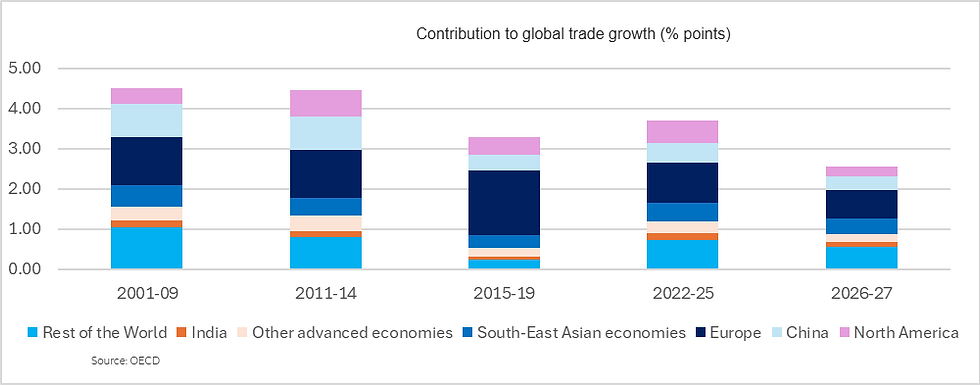
Trade realignment - Heightened trade policy uncertainty in the US has prompted
governments and firms to rethink sourcing and market strategies. Supply chains continue to diversify, with regionalization and nearshoring gaining traction. These adjustments reduce single‑market exposure but introduce transition costs and short‑term frictions that can weigh on trade volumes.
Regional outlook:
In 2025, emerging economies have been resilient, and the unpredictable tariff policy is creating uncertainty in 2026.
China is expected to pursue steadier, more sustainable economic growth in 2026 driven by technology investment, infrastructure, and a gradual re-orientation toward domestic demand. Structural headwinds such as property sector weakness and geopolitical tensions will temper headline growth.
Euro area growth should be modest, supported by selective fiscal stimulus and resilient domestic demand in some member states, though external demand weakness and trade uncertainty will limit upside. Euro area economy is forecast to increase 1.2% next year, owing to fiscal stimulus in Germany and strong growth in Spain.
Japan is likely to see moderate expansion as fiscal measures and improving real incomes support consumption and business investment, offset in part by weaker export demand.
Emerging markets will be heterogeneous: several economies are showing surprising resilience, buoyed by domestic consumption, lower inflation, and improving regional trade links.
AI capex to continue in 2026, despite the AI Adoption starting to flatten out
Corporate investment in AI and related technologies remains a central structural theme. AI Companies may invest over $500 Billion in 2026. Large-scale spending by major cloud and platform providers continues to lift demand for semiconductors, data center infrastructure, and enterprise software. CIOs and risk teams are prioritizing stable, controllable deployments and stronger security postures as adoption moves from pilots to production. While boardrooms are still assessing ROI and implementation risk, the aggregate capex cycle tied to AI is expected to remain a robust.
Probability of recession receded:
Recession risk for 2026 easing as an AI‑driven capex cycle is expected to lift corporate earnings by about ~12–14% over the next year. A rotation of demand toward technology investment is helping to sustain overall growth. Markets are pricing Fed rate cuts as a key 2026 catalyst, but central banks remain vigilant for signs of slowing economic activity and emerging risks.
Key risks to monitor:
Cybersecurity risk: The cybersecurity landscape has become a major concern with rapid adoption of AI platforms. Systemic incidents or successful large‑scale attacks could disrupt operations, erode trust, and impose significant remediation costs.
Climate risks: More frequent extreme weather events are increasing operational and supply chain vulnerabilities. Firms must factor climate risk into continuity planning and capital allocation.
Trade policy and geopolitical tensions: Escalations in trade restrictions, geopolitical conflicts or abrupt policy shifts could trigger rapid repricing in markets and disrupt cross‑border commerce, with outsized effects on export‑dependent sectors.
Financial stress: Persistent inflation or a sharper growth slowdown could strain corporate cash flows and credit markets, exposing vulnerabilities in non-bank financial intermediation and private credit.

Growth in 2026 is expected to remain moderate with downside risks concentrated in trade barriers and policy shocks. Near‑term indicators such as the yield‑curve signal and leading economic indexes point to elevated—but not definitive—recession odds, underscoring the need for contingency planning and stress testing.
Actionable insights for CxOs to prepare for the year ahead:
Align capital allocation, investments with trade policy resilience.
Integrating stress tests into capex decisions, prioritize investments for operational resilience.
Review capital structure, funding sources & investment commitments.
Evaluate opportunities for M&A to shields from geopolitical shocks or market repricing.
Accelerate profitable AI adoption and invest in cyber security.
Shift from pilots to enterprise scale AI projects with measurable margin or revenue gains
Prioritize cyber risk mitigation with investment in cyber security solution.


Comments